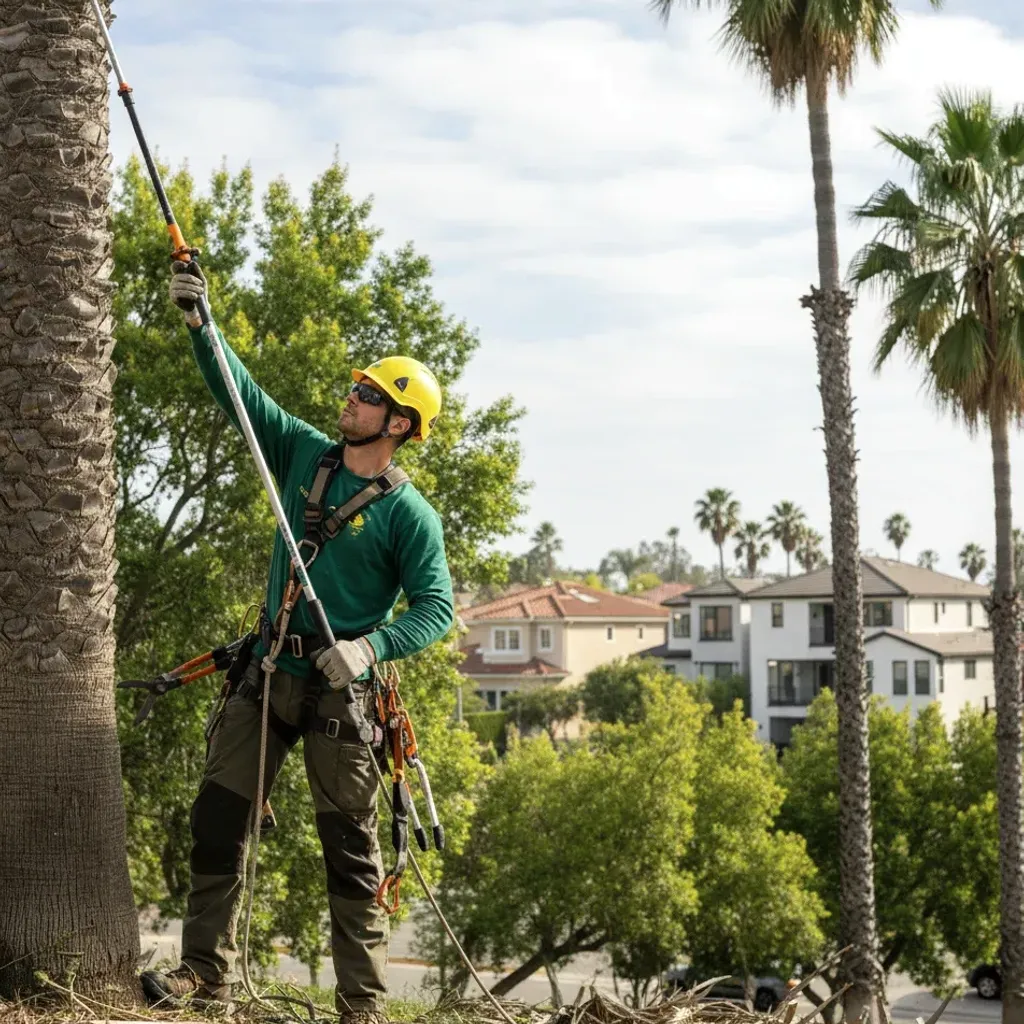
Most HOA tree letters arrive with a deadline and a photo. What they rarely include is the answer to the only real question: who actually owns the trunk, and who has to approve any work.
San Diego County runs from the coast to the high desert. A view fight in Del Mar plays out under different rules than a parkway tree in Chula Vista, and neither looks like a private-lot oak in El Cajon. The geography shapes the paperwork.
Limb SD is a referral service. We connect property owners with licensed, insured independent local tree professionals. The customer hires and pays that professional directly. Limb SD does not perform tree work, appear before a board, or decide who is right.
Safety before paperwork
A live wire and a leaning tree are not HOA problems. They are 911 problems.
If a line is down or a tree is touching a conductor, stay clear. From a safe distance, call 911 and SDG&E at 1-800-411-7343. Per SDG&E’s downed-line guidance, the utility decides whether the line gets de-energized, covered, or moved. Nobody walks closer for a better photo.
Trees that already lean into overhead lines also go to SDG&E first. Safety calls happen before any HOA letter gets answered.
The disputes that show up here
A blocked view from an upstairs window. Lifted pavers along a walkway. A branch that died after last winter’s storms. Fruit, fronds, or sap on a neighbor’s car. An architectural letter that names a date for pruning or removal.
Each of those needs the same baseline record. Photos from the ground. A dated description of what you see. The specific rule the board cited. Without that file, the argument turns on memory.
Tree removal and tree trimming describe different scopes. A pruning notice does not justify a removal quote. A removal notice does not justify a light clean-up. Match the scope to the letter.
When a defensible-space order is part of the case, the defensible space tree requirements post covers the fire-side rules that may apply. That includes State Responsibility Areas under PRC 4291 and locally designated Very High Fire Hazard Severity Zones under Government Code 51182.
Ownership starts with the trunk
California Civil Code 833 places ownership on the parcel where the trunk stands, even when roots cross the property line. Section 834 covers trunks that sit across two parcels, which makes them commonly owned.
Those rules only fix ownership. They do not decide who pays for pruning, who gets access, or who can authorize the cut. A fence is not a survey. Use the recorded survey when one exists.
HOA documents layer in next. Civil Code 4775 sets the default for who maintains common area and who handles a separate interest, unless the declaration says otherwise. Exclusive-use common area can split owner maintenance from association repair. Read the actual designation. The strip between sidewalk and curb is not automatically common area.
Public right-of-way trees follow the city’s process. In the City of San Diego, Urban Forestry issues a no-fee permit after a City inspection for trimming, removal, planting, and root pruning of street trees. City staff decide whether a safety condition exists. A private crew’s schedule is not authority to cut a City tree. City-maintained trees get reported through Get It Done.
A Torrey pine in a City park is a different case than the same species in a back yard. Confirm the parcel, the tree’s exact spot, and any protected or heritage status before any work. Our tree removal permit guide lines up the questions. It does not replace the agency that governs the lot.
How the documents stack
Civil Code 4205 puts state law above the governing documents. Within those documents, the declaration outranks the articles, those outrank the bylaws, and those outrank operating rules. CC&Rs matter. They do not outrank statute.
Request the current CC&Rs, the architectural standards, and any tree or view policy from management. Read the landscaping, maintenance, architectural control, and use-restriction sections. Check whether planting, major pruning, or removal needs committee approval before it happens.
Building the file
Put every exchange in writing. Ask a specific question. Attach the photos, the survey if you have one, and the rule you are citing. Date every email. Send a follow-up note after any phone call.
Do not cut a protected tree or a right-of-way tree to cure a notice. The cure can become a second violation.
When the association is moving toward covered discipline or a common-area charge, Civil Code 5855 requires written notice at least 10 days before the meeting, a chance to address the board, an opportunity to cure, and a written decision within 14 days if a discipline or charge is imposed. That timeline does not apply to every tree-work request. Disputed deadlines belong with a California attorney.
Internal dispute resolution
For covered disputes between an association and a member, Civil Code 5910 requires a fair, reasonable, and fast internal process. The member invokes it in writing. If a member invokes it, the association has to participate. A member may decline when the association invokes it. The association cannot charge a fee to take part. Your own attorney or adviser costs are separate.
Civil Code 5930 makes an ADR attempt a prerequisite for certain superior-court enforcement actions, with scope limits and exceptions. Small claims is excluded. This is not a green light to sue, and it is not a rule that every tree fight goes to mediation first. Legal rights belong with a qualified California lawyer.
When a written report helps
A scoped tree report carries weight when the dispute needs more than photos. Put the scope in writing before anyone climbs the tree. Name the assessor. List what they will observe, what they may infer, and what the report will not cover. Species, visible defects, and recommended work belong inside that scope.
ISA certification is held by an individual. A missing entry in the ISA directory does not, by itself, disprove a credential. Ask for the digital certificate when the credential matters to the case.
Arborist consultation and tree health diagnosis are separate services from cutting. Match them against the question the board actually asked.
For paid work, check the contractor on the CSLB license lookup. An active C-49 or an active legacy D-49 can both be valid. The professionals Limb SD connects you with can pull a required permit when that task sits inside the agreed scope. The matched professional quotes before any cutting starts.
Frequently asked questions
Does the HOA own the tree in the sidewalk strip?
Not automatically. Confirm the parcel, the right-of-way, and the declaration. City street trees follow the city’s process even when an HOA requests work.
Can CC&Rs override state law?
No. Civil Code 4205 puts the law above conflicting governing documents. The declaration, articles, bylaws, and rules then rank in that order.
Is the 10-day board notice required for every tree job?
No. The 10-day and 14-day timelines in section 5855 apply to covered discipline and specified charges. They are not a statewide tree-work notice.
Will an arborist report force the board to accept the plan?
No. A scoped written report supports a discussion. It does not bind the board.
Can Limb SD settle the dispute?
No. Legal questions belong with a California attorney. The licensed, insured independent professionals in our network handle assessment or work you hire directly.
When to call a tree professional
Call when ownership and approvals are clear and a written scope is ready. A licensed local professional can quote the job before any cutting starts, and the price moves with tree size, species, access, hauling, permits, and whether a crane is needed.
Call (858) 400-4587 and Limb SD will connect you with a licensed local tree professional.