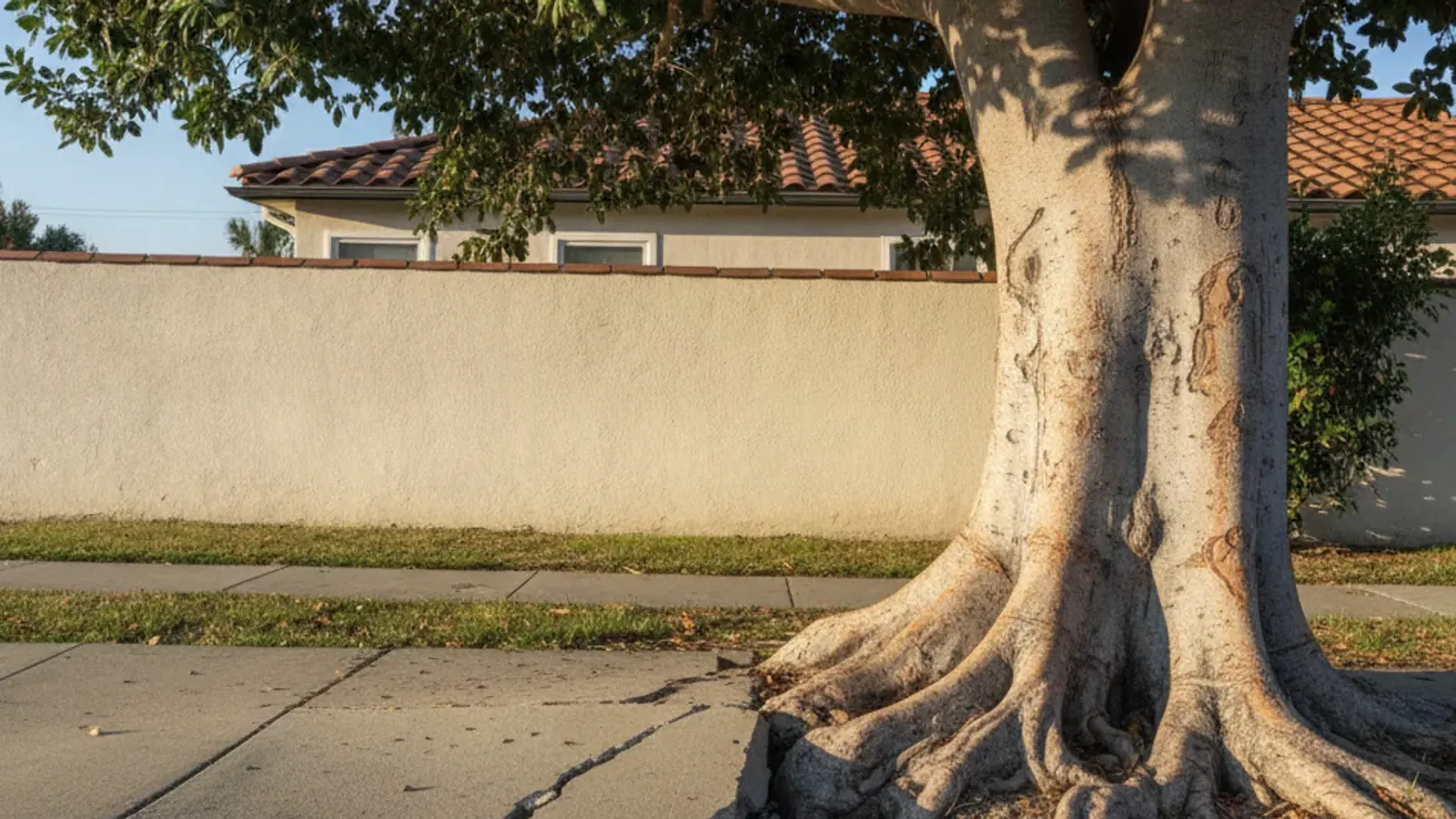
San Diego County homeowners run into ficus trees in three places: as a hedge along a side yard, as a parkway tree on a city sidewalk, and as the headline-grabbing specimen at Balboa Park. Each one raises a different question, and each one ends in a phone call to someone who knows what to do with it.
Limb SD is a referral service connecting San Diego County property owners with licensed, insured independent tree professionals. The customer hires and pays that professional directly. Limb SD does no tree work.
Start with the species in your yard
Two species handle most of the residential load in this region. A third shows up mostly in parks and large public spaces.
Indian laurel fig, listed as Ficus microcarpa, carries glossy oval leaves on smooth gray bark. Open ground lets it build out a wide, rounded canopy. Cal Poly’s Selectree puts a mature specimen near 60 feet tall and 55 feet across, and rates the species as a moderate root-damage risk. The same profile notes the tree does not belong under utility lines.
Weeping fig, recorded as Ficus benjamina, sends out long, drooping branchlets and leaves with long, tapered tips. A formal hedge can hide those traits for years, so confirm what is actually growing before any decision gets made. The NC State plant profile covers the species in more detail.
The Balboa Park tree is its own reference
The famous tree at Balboa Park is not a yard tree. Balboa Park’s Moreton Bay Fig page identifies the specimen as Ficus macrophylla, planted in time for the 1915 Panama-California Exposition. A 1996 survey recorded roughly 78 feet in height, a 123-foot crown spread, and a trunk girth of about 486 inches. The same page places the tree among California’s three largest Moreton Bay figs. Foot traffic compacted the soil around the root zone and damaged surface roots, and the park fenced the area in response. A homeowner with a cracked sidewalk almost never has this species in the yard, and the park tree’s size should not anchor a residential quote.
What actually moves the slab or blocks the pipe
A ficus beside lifted pavers is a clue, not a verdict. Original grading, soil type, drainage patterns, and past trenching all push slabs and pavers around. The matched professional starts by mapping root flare, paving movement, and the distance between them. A backed-up drain is a separate investigation, owned by a plumber with a camera, not an arborist.
UC Integrated Pest Management notes that cutting or crushing established roots can trigger a slow decline that shows up years later. Big root losses also weaken anchorage, especially in the wet winter soils common across coastal San Diego. The reason the standard move is to identify the cause before removing anything visible is exactly that risk.
The pipe and the tree are two tracks
The sewer lateral and the tree above it belong to different conversations. A camera inspection and a plumbing report establish the pipe’s condition, age, and material. Roots near the line get factored in afterward, not before. Tree work that ignores the pipe leaves the pipe problem standing. Pipe work that ignores the tree risks the kind of root loss UC IPM warns about. Running both investigations in parallel, with the matched professional coordinating with the plumber, usually produces the cleanest result.
Root barriers: a redirect, not a cure
A root barrier can steer new growth away from a target, but it does not work like a permanent wall. Soil type, drainage, depth of the barrier, and the existing root layout all shape what comes next. Putting one in usually means excavating through roots that are already there.
Before signing off on a barrier, the property owner and the matched professional should agree on:
- which surface roots the dig will expose or sever
- whether lifting the paving a different way avoids big root loss
- where public and private utility lines run
- whether the target is the slab, the pipe, or both
- how the work changes the tree’s stability rating
A paving contractor and a tree professional working from the same plan produce better results than two separate scopes.
Pruning: name the goal, then the cut
Each cut needs a stated purpose before the saw starts. Removing dead wood, lifting canopy clearance, or correcting a specific structural issue all count as purposes. “Thin it out” or “shape it up” do not.
The International Society of Arboriculture’s mature-tree pruning guide points out that older trees usually need a smaller share of foliage removed than younger ones. Species, age, condition, and the target result all shape the answer. Routine thinning by itself does not improve tree health.
Topping is a separate problem. ISA notes that indiscriminate heading cuts stress the tree, open up interior tissue, and force out weakly attached regrowth. Ask whoever writes the scope to name specific branches and a goal, not a percentage of the canopy. Our tree-pruning service page and tree-trimming service page walk through those distinctions.
When removal enters the picture
Removal becomes a real option when defects, root loss, or site conflicts cannot be managed to an acceptable level. It also earns consideration when a needed repair would keep coming back to disturb important roots.
A good removal scope sets out:
- tree height, stump option, and root work
- access for trucks and the chip hauling path
- protection for nearby paving, walls, and plantings
- utility and irrigation line locations
- debris haul and final grade
- what kind of restoration the customer wants at the end
Independent professionals price the work based on the actual site. Limb SD does not set prices, and no two quotes include the same work. Our tree-removal service page runs through the work categories worth comparing.
Street trees, parkway strips, and permits
A ficus growing in the parkway strip between sidewalk and curb is not always the homeowner’s tree. Many parkway trees sit inside a public right-of-way, and the city, not the homeowner, controls the work.
The City of San Diego’s street-tree maintenance page lays out a No-Fee Permit process that covers trimming, removal, planting, and root pruning once a city inspection has taken place. Concerns about city-maintained trees go through the Get It Done reporting tool. A private crew’s availability is not the same as a permit.
Other cities in San Diego County follow their own rules, so confirm the parcel’s jurisdiction, the tree’s location, and any protected status before any work begins. Our San Diego tree-permit guide runs through the questions worth asking.
Common questions
Does a ficus always damage nearby paving?
No. Cal Poly lists Ficus microcarpa’s root-damage potential as moderate, not certain. Slab condition, soil type, drainage, and prior root cuts all weigh more than the species label.
Does a ficus with exposed roots need to come out?
Not always. Exposed roots call for a site visit. Removal enters the picture when root loss, structural defects, or a site conflict cannot be brought to a safe level.
Will cutting roots fix a sewer backup?
No. A camera inspection and a plumbing report should establish the pipe’s condition first. The tree side of the decision follows once the pipe side is known.
How far from paving should a ficus be planted?
Use the species’ mature size, the local soil, drainage, nearby utilities, and the available root space before choosing a spot. Cal Poly’s profile shows a broad canopy and a moderate root-damage rating for Ficus microcarpa.
Does a private-property ficus need a removal permit?
Possibly. Rules depend on the city or county, the tree’s location, and any protected status. Confirm with the local jurisdiction before any work begins.
How do I compare removal quotes?
Ask each independent professional to quote the same scope: the same tree, the same access, the same nearby targets, the same stump option, the same root work, the same debris haul, and the same site restoration.
When to call a tree professional
Call when roots, paving, pipes, or pruning decisions involve a tree you cannot fully see from the ground, or when a permit question needs a site visit. Call (858) 400-4587 and Limb SD will connect you with a licensed local tree professional.